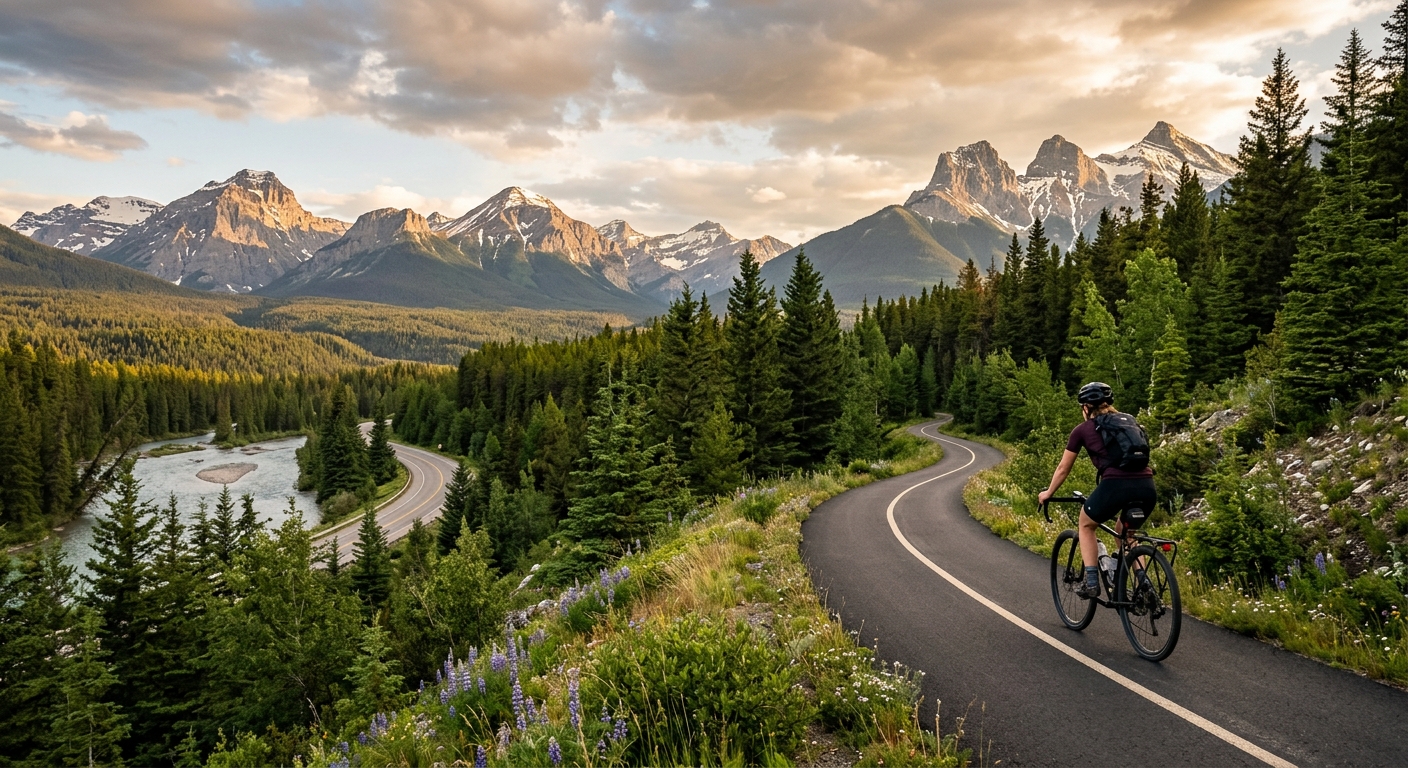
The Legacy corridor is a useful way to plan a paved ride around Banff and Canmore, but the destination names hide several different distances. A section from Banff towards Canmore, the full route from the Bow Valley Parkway and an out-and-back to a chosen picnic stop are different days. Begin with the actual start, endpoint and return arrangement, then choose a bike that fits the rider and the route.
What the Legacy Trail distance measures
Parks Canada's detailed Legacy guide lists 26.8 km of corridor segments between the Bow Valley Parkway and the Travel Alberta Visitor Information Centre in Canmore, excluding the separate 2.2 km connection through Banff town. Its summer bike inventory gives 29 km one way for the wider route. Identify the measurement basis instead of describing every Banff–Canmore ride as 26 km.
| Published segment | Distance | Planning implication |
|---|---|---|
| Bow Valley Parkway to Vermilion Lakes Drive | 1.7 km | Western section; not part of every eastbound ride starting in town. |
| Vermilion Lakes Drive | 4.3 km | A road section within the wider corridor, not a lake detour automatically encountered on a Banff-to-Canmore ride. |
| South Norquay Road to railway tracks | 0.6 km | Connects the western corridor with town. |
| Through Banff to the east end of Banff Avenue | 2.2 km | Town crossings and route choices; excluded from the 26.8 km figure. |
| East end of Banff Avenue to Cascade Ponds connector | 3.4 km | Choose the actual access point on the official map. |
| Cascade Ponds connector to Banff East Gate | 12.3 km | A longer corridor section; keep supplies and a return plan. |
| East Gate to Canmore Visitor Information Centre | 4.5 km | Arrival is not downtown Canmore; further town connections add distance. |
These are published segment measurements, not a timed itinerary. Parks grades the cycling route Easy, but notes short steep hills and rolling terrain. Paving does not remove road crossings, shared-path users, wind or the effort of a long return. Choose for the least experienced rider and leave room for stops rather than relying on a universal speed.
Choose a starting point
Parks recommends Cascade Ponds as a parking/start option and also identifies Fenlands Recreation Centre, the train-station lots, Valleyview and Fenland. A parking location is an approach to the route, not necessarily the zero point of the full published corridor. Check the official map, current parking rules and the ride to the actual path before collecting the rental.
A Banff base can suit a shorter local section followed by a meal in town. A Canmore base changes the approach and the return logistics; use the town comparison. If Vermilion Lakes is the main interest, plan that western section directly rather than expecting it to appear after setting off east towards Canmore.
One way, out and back, or bus return?
An out-and-back with a chosen turnaround gives the group control over the return distance. A full one-way crossing needs transport for both riders and bikes. The route towards Canmore should not be sold as predictably easier or as a way to avoid an afternoon headwind: use the day's forecast and the actual riders' ability.
Roam's bicycle policy provides first-come rack space, with further carriage depending on the bus, fit, available interior racks and driver decisions. A passenger reservation does not reserve a bike slot. Check the regional service, exact stops, final departure and whether everyone can load their own bike. Have a plan if the group cannot board together or the rack is full; the bus is not a guaranteed rescue for an overlong ride.
Pedal bike or e-bike
The Legacy Trail is a named pedal-assist exception in the current Parks order. Ask the rental provider to confirm that the exact bike meets the complete definition, including motor output, assistance cut-off and safety mechanism. That exception does not authorize every nearby trail. A detour onto an unlisted path can change the permission even when the main ride is permitted.
Ask about fit, braking, changing gears, battery range for the real route, what equipment is included, a basic repair plan and the return deadline. Obtain a current total quote rather than relying on an old daily-price range. Banff Adventures is at 211 Bear Street in Banff. Wilson Mountain Sports is at Samson Mall, 101 Lake Louise Drive in Lake Louise, a separate town and journey.
Season, gates and shared-path preparation
Parks describes a weather-dependent three-season route and warns that it is not cleared of winter snow and ice. The warning runs from the first fall snow until spring maintenance resumes, with possible plow debris, closed gates, ice and deep snow. A calendar month does not establish a rideable surface. Choose the reviewed winter fat-bike routes rather than assuming this paved summer corridor is a prepared winter ride.
Follow the instructions at wildlife gates and electrified rubber mats. People walking and pets should use the pedestrian gates; cyclists should follow the posted crossing instructions. Slow for other users, yield appropriately and stop off the riding line. Carry water, food, layers, navigation, first aid and repair equipment for the real outing; do not plan around an assumed open shop between endpoints.
Check the cycling planner, packing guide and official reports. The Town's guidance distinguishes the under-18 helmet rule for pedal bicycles from the all-ages requirement for electric/power-assisted bicycles. A helmet is sensible for every rider.
An Expedia accommodation search and GetYourGuide cycling search are affiliate links; BanffBound may earn a commission. They do not confirm an available tour or a bike transfer.
Sources and review
Reviewed October 29, 2026 against the linked Parks route and e-bike order, Roam policy, Town guidance and operators' location pages. Recheck the trail report and bulletins before the ride. This source review is not a current-open or surface report.
Enjoyed this guide? Get weekly Banff tips.