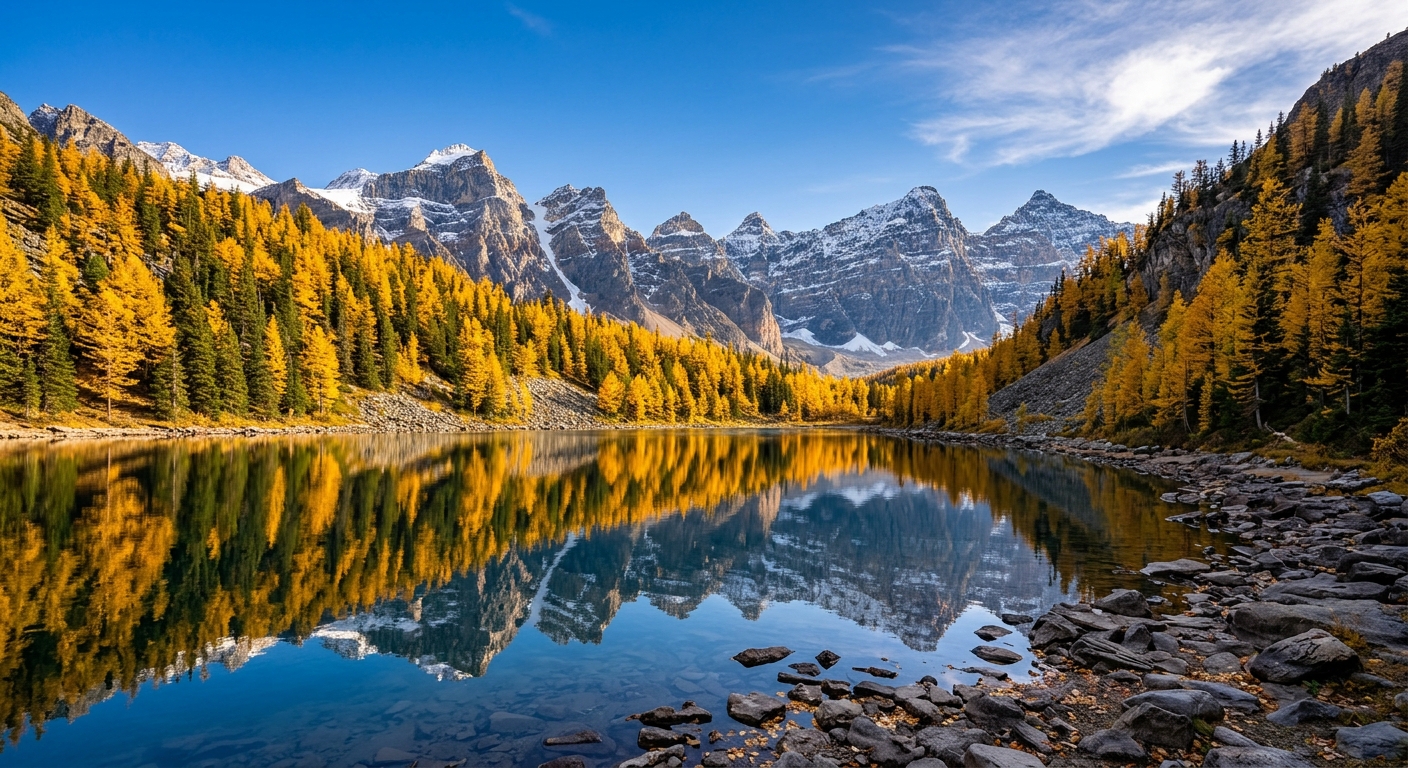
A larch trip works best when the whole outing matters: the forest, the mountain setting and time together, as well as golden needles. Start with a route your group wants to walk, then connect the seasonal transport, conditions and return. Colour is one part of the plan, rather than a condition a reservation can deliver.
Full guide reviewed October 29, 2026. This guide helps with timing and preparation. The larch route planner compares five reviewed summer profiles by starting area and published return estimate. For the wider choice of September or October bases and activities, use the fall travel guide.
Use a broad colour window, then look at the actual trip
Larches change colour and shed their needles, unlike the evergreens around them. Banff & Lake Louise Tourism describes the typical display from late September into early October. It does not establish one peak day for every elevation, aspect or year. This guide contains no live foliage feed, historical peak chart or year-specific forecast.
Choose travel dates that also suit the party’s availability and the activities you value if colour is patchy or gone. If hiking is the main reason to travel, investigate transport and route demands before choosing a room. If you mainly want a scenic autumn break, allow a town or lakeshore day to be worthwhile without a high pass.
Close to departure, read the official trail report and note the observation date, not just the route name or summer grade. A picture from another week can help you understand a landscape but does not establish today’s colour, surface or access.
Choose an endpoint, not a list of interchangeable hikes
| Choice | What changes | Useful next step |
|---|---|---|
| Larch Valley or Sentinel Pass | The valley/lakes endpoint and the higher pass have separate published profiles. The upper pass adds demands; it is not a compulsory extension. | Compare Larch Valley / Minnestimma Lakes with Sentinel Pass. |
| A shorter published estimate | A shorter return estimate does not mean easy terrain. Saddleback is graded Difficult. | Read the complete Saddleback profile and its lakeshore starting point. |
| A different starting area | Taylor Lake and Healy Pass create separate highway/base-area journeys; they are not quieter or easier equivalents of a Moraine Lake hike. | Use the planner’s starting-area filter and the route’s full source checks. |
For figures, grades and endpoints, read the Parks Canada profiles linked through each reviewed trail. Avoid adding a full Sentinel distance to a full Larch Valley distance: the pass profile already includes its approach. Choose the complete return for the least experienced member, including the descent, before adding another stop.
Healy Pass is not reached by shortening its hiking profile with the Sunshine gondola. Its reviewed route begins at Sunshine’s lower base, while Sunshine Meadows is a separate lift-served network. At this review, the operator marked Meadows closed for summer 2026 and published June 25–September 19, 2027 as future summer dates. Confirm the actual product; a late-September colour trip does not establish gondola access.
Resolve the starting point and the last useful return
Moraine Lake, Lake Louise lakeshore, the village and the ski-resort Park and Ride are different places. Under Parks’ lake-access rules, Moraine Lake Road is closed to personal vehicles year-round, with specified authorized exceptions. Confirm which service and check-in applies to your party, then the journey from your accommodation to that departure.
The published 2026 Parks lake-shuttle season ended October 12. Recheck the actual future season and reservation instructions; do not copy that date into another year. A transport ticket can establish its stated journey without establishing a suitable mountain hike or a spare seat at a different stop.
- Choose the route and start. Read the whole profile, current report and any restriction.
- Join the outward legs. Include reaching the departure point, check-in and getting from the drop-off to the trail.
- Work back from the return. Account for the walk down, waiting and the final accommodation connection. Set a turnaround plan with room for a slower party or changed conditions.
- Choose a different day when needed. A paid room or ticket does not require completing a mountain objective.
Use lake transport planning and the car-free guide. If driving to another starting area, use designated parking and check the actual road leg. This guide supplies no occupancy prediction or arrival clock that guarantees a space.
A colour window does not approve a snowy summer route
The Lake Louise-area routes in this comparison carry Parks’ avalanche warning against travel from mid-October to mid-June. Healy Pass needs its own snow-season assessment. The snow-season setting changes preparation notes; it does not turn the summer profiles into winter recommendations.
Check conditions, weather and the current park notices. A clean highway, a summer route marker, another person’s tracks or traction devices do not assess a snow slope. If the planned hike no longer fits, choose a different kind of outing from the day-choice tool, rather than moving to another alpine trail on the assumption it is safer.
Prepare the group and the whole day’s kit
Parks’ trail-report guidance recommends travelling in tight groups of four or more. A specific mandatory group order, when posted, has its own area and conditions. Read the actual notice for the route; do not infer a special rule for every larch trail from an old article. If booking a guide, confirm the route, party arrangements, skills expected and what changes if the objective is unavailable.
Carry appropriate footwear, warm and weatherproof layers, gloves, a hat, food, water, navigation, a headlamp and emergency supplies for the outing. Resolve bear-spray carriage and use before leaving. The hiking packing checklist can organise equipment; its summer label does not establish summer conditions in autumn.
Plan for the least experienced member and discuss everyone’s pace, recent hiking experience and assistance needs before choosing the route. Stay together and tell a reliable person the plan and expected return. A faster walker, guide or emergency device does not make it sensible to separate the group or continue beyond the agreed objective.
Keep photography inside the outing you can complete
Look for compositions from the designated trail or viewpoint: a small branch, the contrast with darker forest or a wider mountain scene can all tell the story. Work with the light and weather you find. There is no fixed morning clock that makes every grove photogenic or makes an early departure suitable for every transport plan.
Keep paths and boarding areas clear when stopping. Protect vegetation, give wildlife space and keep the return plan ahead of one more photograph. Use photo-location planning for other subjects; sunset or stars are separate outings requiring their own access and journey checks.
Book the complete trip and preserve another kind of day
Compare accommodation and transport together. A room close to the wrong departure point may not simplify the outing. Use Lake Louise base planning and the reviewed stay comparison to distinguish village, lakeshore and wider road locations.
The trip-cost calculator can compare your own room, transport, food and activity quotes in CAD. Leave unknown amounts visibly unknown and check the cancellation terms of each dependent booking. Neither a quoted room nor a published colour window guarantees the outing.
The retained GetYourGuide Banff activity search is an affiliate link; BanffBound may earn a commission. These are search results, not a verified larch tour or a reservation. Check the actual operator, route, date, transport, group rules and terms on the selected listing.
Larch trip questions
When should I plan a Banff larch trip?
Banff & Lake Louise Tourism describes a typical late-September to early-October colour window. That is broad seasonal context, not a peak-date forecast for a particular year or trail. Book a trip you can enjoy if colour, cloud or snow differs from the photograph you hoped for, and check current access and conditions near departure.
Do I need to climb Sentinel Pass to visit Larch Valley?
No. Larch Valley / Minnestimma Lakes is a separate published endpoint. Sentinel Pass continues higher and has its own Difficult profile. Choose the endpoint, demands and complete return before leaving, rather than treating the upper pass as a compulsory finish to see larches.
Is a group of four always a special larch-season requirement?
Parks Canada’s general trail guidance recommends tight groups of four or more. Specific mandatory restrictions come from current orders and posted notices for the actual route. Read those separately; an old seasonal article or a generic tour listing does not establish the rule or confirm that a particular party meets it.
Can I drive to Moraine Lake or use any Lake Louise bus?
Moraine Lake Road is closed to personal vehicles year-round, with specified authorized access exceptions. Arrange the actual seasonal service, check-in and return. A Lake Louise lakeshore bus is a different journey from a Parks shuttle departing the ski-resort Park and Ride, and neither establishes a future Moraine Lake seat.
Does snow make these larch routes winter walks?
No. These comparisons use summer hiking profiles. Parks advises against mid-October to mid-June travel on the listed Lake Louise-area routes because of avalanche exposure. Healy Pass also needs its own snow-season assessment. A shorter route, microspikes or a clear road does not approve a snowy mountain outing.
Sources and review
Full guide reviewed October 29, 2026. Tourism’s broad colour window, Parks’ route/access/report guidance and Sunshine’s dated summer information inform this guide. Current reports and actual confirmations remain separate. The hero image is illustrative and is not verified as a named grove, route, season or present colour.
Enjoyed this guide? Get weekly Banff tips.