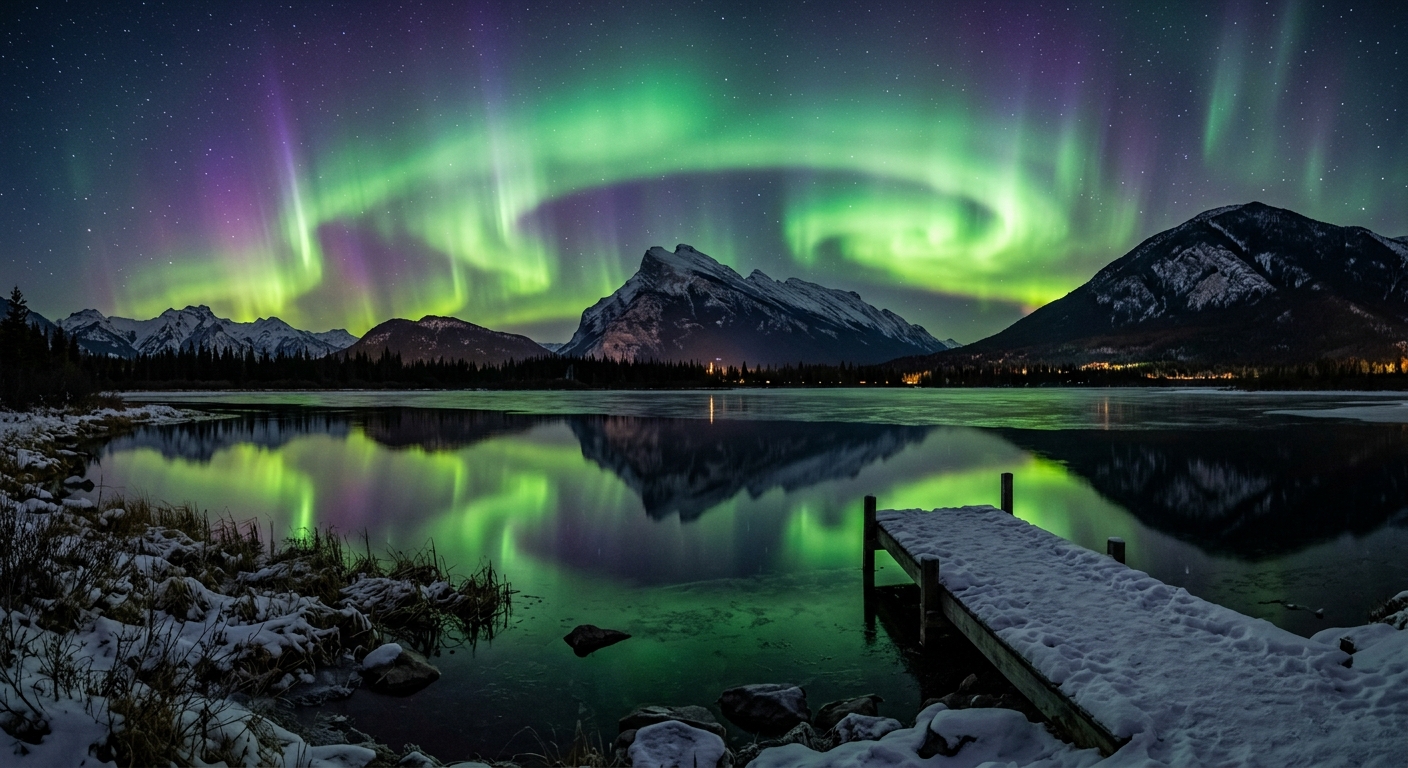
The northern lights — or aurora borealis — are one of nature's most dramatic phenomena, and Banff National Park is one of the best places in the world to see them. While Banff isn't as far north as Yellowknife or Iceland, its latitude (51°N), dark skies, and mountain scenery combine to create exceptional aurora viewing when conditions align.
Best Time to See the Aurora
The northern lights are visible in Banff primarily from September through March, when nights are long and dark:
- Peak months: October, November, February, March — longest dark periods with often clear skies
- Best hours: 10pm to 2am, though strong displays can start earlier or last until dawn
- Moon phase matters: A new moon or crescent moon means darker skies and more visible aurora
- Solar activity: The aurora is driven by solar wind. During solar maximum periods (like the current cycle peaking 2024–2026), displays are more frequent and visible at lower latitudes like Banff
Best Viewing Spots
Vermilion Lakes
The number-one aurora viewing spot near Banff. The lakes face north with an unobstructed horizon, and the calm water reflects the aurora, doubling the spectacle. Mount Rundle and the Sundance Range frame the scene. Drive to the third lake (furthest west) for the darkest skies.
Lake Minnewanka
The large lake with a north-facing shoreline offers excellent aurora viewing. The drive from Banff is only 15 minutes, and the parking area provides easy access to a wide-open sky. The mountains on either side frame the aurora beautifully.
Two Jack Lake
Two Jack Lake is smaller but offers exceptional aurora viewing with Mount Rundle as a silhouette backdrop. The lake's calm surface can create remarkable reflections of the aurora dancing above.
Bow Lake (Icefields Parkway)
If you're willing to drive 90 minutes north, Bow Lake offers some of the darkest skies in the Banff area. At 1,920 metres elevation and far from any town light, the aurora viewing here is outstanding.
Castle Junction (Bow Valley Parkway)
The open areas along the Bow Valley Parkway near Castle Junction offer north-facing views with minimal light pollution. Pull off at any wide spot along the road for an impromptu aurora viewing session.
Aurora Forecasting Apps & Tools
- My Aurora Forecast: The most popular aurora app — provides real-time Kp index, cloud cover, and alerts
- SpaceWeatherLive: Detailed solar wind data and aurora predictions
- NOAA Space Weather: Official US government space weather forecasts
- Aurora Watch (University of Alberta): Canadian-specific aurora alerts — sign up for email notifications
Set alerts for Kp 4 or higher — at Banff's latitude, Kp 4+ typically produces visible aurora. During Kp 6 or higher, expect a striking display.
Photography Tips
- Tripod: Essential — you'll need exposures of 5–25 seconds
- Wide-angle lens: 14–24mm at f/2.8 or wider is ideal
- ISO: Start at ISO 3200 and adjust. Modern cameras handle this well
- Manual focus: Set focus to infinity on a distant light, then switch to manual focus
- Shoot RAW: The aurora's colours are more recoverable in post-processing from RAW files
- Include foreground: Mountains, lakes, and trees make aurora photos far more compelling than just sky
Practical Tips
- Dress extremely warm: You'll be standing still in the cold for hours. Layer up with thermal base layers, insulated jacket, and warm boots
- Bring hot drinks: A thermos of hot chocolate or coffee makes the wait comfortable
- Be patient: The aurora can appear suddenly, fade, and reappear. Give yourself at least 2 hours at your viewing spot
- Wildlife awareness: You're in bear and elk country, even at night. Make noise, carry bear spray, and be aware of your surroundings
Book your aurora-viewing trip to Banff on Expedia. Add stargazing and night-sky tours for a guided northern lights experience.
Enjoyed this guide? Get weekly Banff tips.