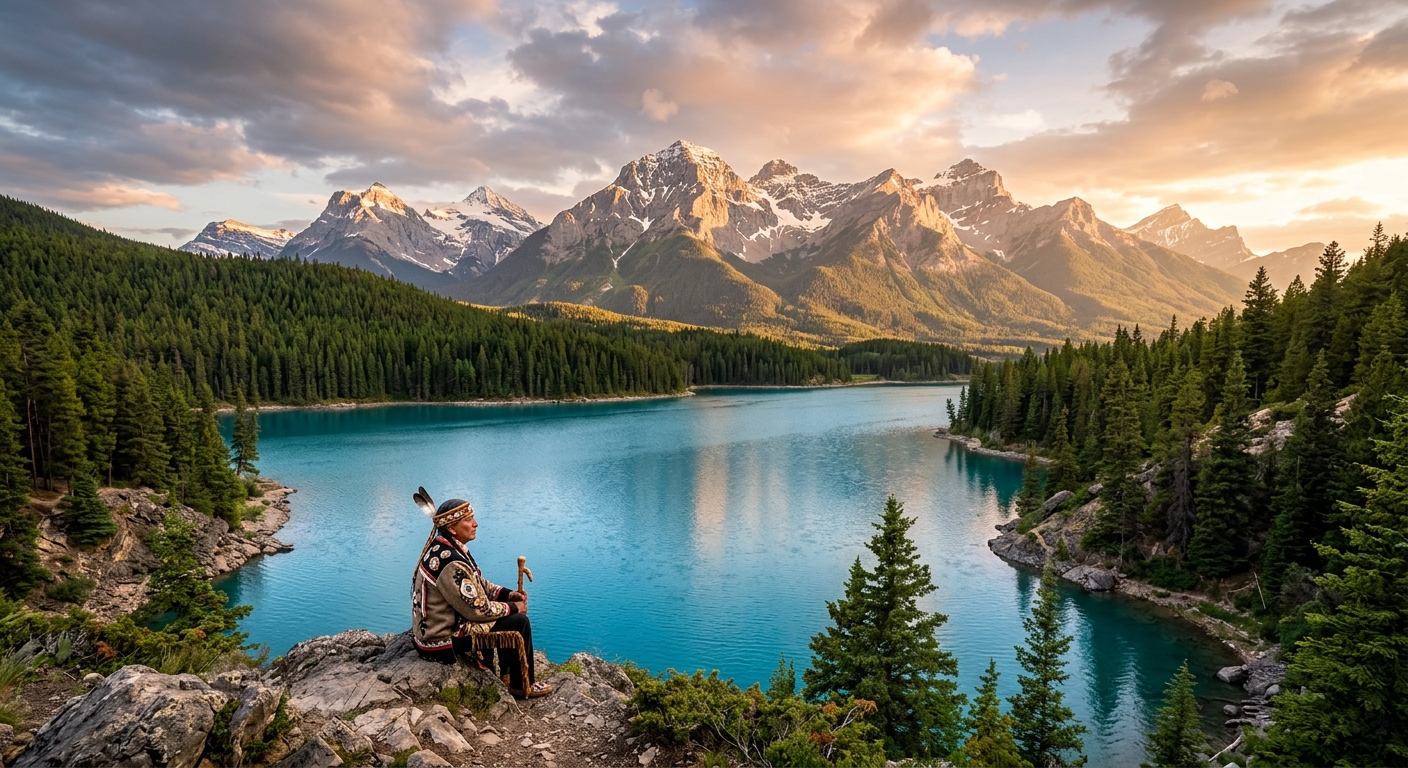
Long before Banff was a national park, a resort destination, or a stop on the railway, the mountains, valleys, and rivers of this region were home to Indigenous peoples for over 10,000 years. The Stoney Nakoda (Iyarhe Nakoda), Blackfoot (Niitsitapi), Ktunaxa (Kootenay), and Tsuut'ina Nations all have deep, enduring connections to this land — connections that predate and transcend the boundaries of the national park.
The First Peoples
Stoney Nakoda (Iyarhe Nakoda)
The Stoney Nakoda people have the most direct and continuous connection to the Banff region. They called the area "the shining mountains" and used the valleys as seasonal hunting grounds, following bison, elk, and bighorn sheep through the passes. The hot springs at Banff were sacred healing places, and the mountain passes served as vital travel corridors between the plains and the Columbia Valley.
Blackfoot Confederacy (Niitsitapi)
The Blackfoot Confederacy — comprising the Siksika, Piikani, and Kainai nations — controlled vast territory on the eastern slopes of the Rockies and the northern plains. The mountains formed the western edge of their territory, and they used the foothills and front ranges for hunting, spiritual practices, and gathering medicinal plants.
Ktunaxa (Kootenay)
The Ktunaxa people's territory extended from the western slopes of the Rockies into the Columbia Valley. They regularly crossed the mountain passes — including what is now Banff — to hunt bison on the plains. The mountain passes were critical travel and trade routes for the Ktunaxa.
Tsuut'ina Nation
The Tsuut'ina people, closely allied with the Blackfoot, occupied territory south and west of present-day Calgary. Their hunting grounds extended into the eastern foothills of the Rockies, and they used the mountain valleys for seasonal camps and spiritual practices.
Displacement and the National Park
The creation of Rocky Mountains Park (later Banff National Park) in 1887 was not a neutral act of conservation. The establishment of the park, combined with the expansion of the railway and the signing of Treaty 7 in 1877, systematically displaced Indigenous peoples from lands they had occupied for millennia.
Treaty 7, signed by the Blackfoot, Stoney Nakoda, and Tsuut'ina with the British Crown, was understood very differently by each side. Indigenous signatories understood it as a peace agreement and a sharing of land — not a surrender of their rights to it. The subsequent creation of the national park and exclusion of Indigenous peoples from their traditional territories represents one of the most painful chapters in the region's history.
Reconciliation and Recognition
In recent years, Parks Canada has taken significant steps toward reconciliation:
- Land acknowledgments: Parks Canada now acknowledges the traditional territories of Indigenous peoples at park entrances and facilities
- Indigenous place names: Efforts to restore or recognize Indigenous place names alongside colonial names
- Cultural programs: Indigenous-led cultural programs, including storytelling, guided walks, and traditional knowledge sharing
- Co-management: Increasing Indigenous involvement in park management decisions
- Buffalo Treaty: The Stoney Nakoda and other nations have been involved in efforts to restore wild bison to the park
How to Learn More
- Whyte Museum: Exhibitions on Indigenous history and culture in the Banff region
- Cave and Basin: Displays acknowledging Indigenous knowledge of the hot springs
- Buffalo Nations Luxton Museum: Dedicated to the Indigenous peoples of the Northern Plains and Rocky Mountains
- Guided experiences: Look for Indigenous-led tours and cultural programs offered through Parks Canada
Deepen your understanding of this land by booking cultural tours and guided experiences. Find accommodation on Expedia.
Enjoyed this guide? Get weekly Banff tips.