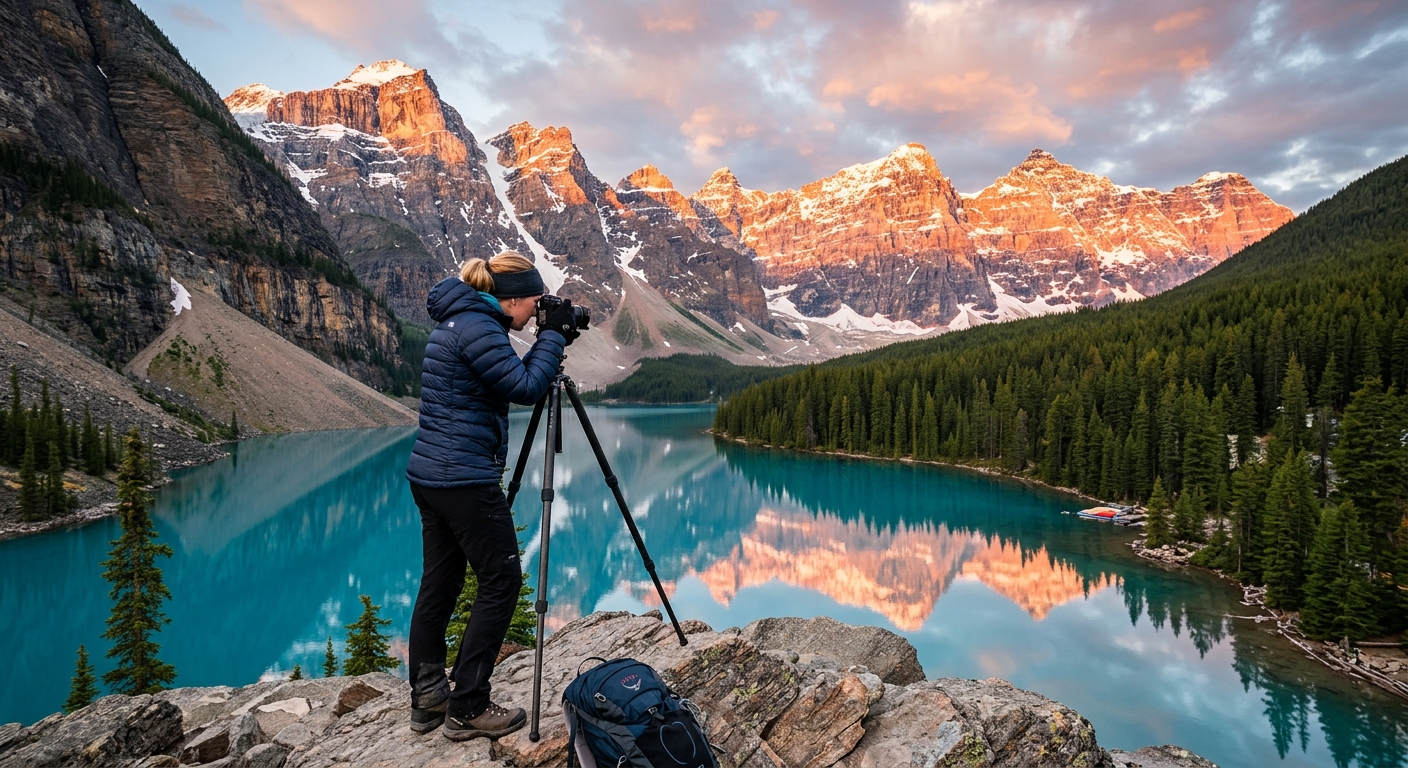
Banff is one of the most photographed places on Earth — and for good reason. This 3-day photography itinerary hits the iconic shots while also revealing lesser-known compositions. From sunrise to starlight, every hour offers something worth capturing.
Day 1: Iconic Sunrise & Town Views
Sunrise: Vermilion Lakes (5:30 AM arrival)
The classic Banff sunrise shot. Three lakes reflect Mount Rundle in perfect symmetry on calm mornings. Set up at the second lake with a wide-angle lens. The reflection is best before 7 AM when wind picks up.
Gear: Tripod essential. Wide-angle 16-35mm. Polarizing filter for sky contrast.
Morning: Two Jack Lake
Drive to Two Jack Lake for reflections of Mount Rundle from a different angle. The lakeside dock is an iconic foreground element. Morning light (8-10 AM) is warm and directional.
Golden Hour: Surprise Corner
Walk to Surprise Corner viewpoint in late afternoon. The Fairmont Banff Springs Hotel framed by mountains and forest is one of the most recognisable compositions in the Rockies. Best light 1-2 hours before sunset.
Evening: Banff Gondola or Town
If clouds are building, ride the Banff Gondola for dramatic sunset skies above the cloud layer. Alternatively, photograph Banff Avenue with Cascade Mountain as a backdrop at blue hour.
Day 2: Lake Louise & Moraine Lake
Sunrise: Lake Louise (arrive by 6 AM)
The Chateau Lake Louise and Victoria Glacier reflected in turquoise water. The sunrise shot here is world-famous — and worth the early wake-up. Use a telephoto (70-200mm) to compress the glacier and hotel.
Mid-Morning: Moraine Lake
The Rockpile Trail at Moraine Lake provides the classic Valley of the Ten Peaks composition. This is arguably the most photographed scene in Canada. Morning light illuminates the peaks from the east.
Tip: The 20-dollar-bill view. Bring a wide-angle lens and capture the turquoise lake with all ten peaks.
Afternoon: Lake Agnes & Big Beehive
Hike to Lake Agnes for a unique aerial perspective of Lake Louise below. Continue to Big Beehive for the highest viewpoint — the turquoise of Lake Louise from above is impressive.
Sunset: Bow Lake
Drive to Bow Lake on the Icefields Parkway. The red Num-Ti-Jah Lodge against turquoise water and Crowfoot Glacier makes a beautiful sunset composition.
Day 3: Peyto Lake & Local favourites
Sunrise: Peyto Lake Viewpoint
The fox-head-shaped lake viewed from above is one of Banff's most iconic images. Arrive early for parking and the best light. The viewing platform provides a perfect elevated perspective.
Morning: Mistaya Canyon
A short walk from the Icefields Parkway, Mistaya Canyon offers dramatic water-carved rock formations. Use a slow shutter speed (1-2 sec) to create silky water effects in the narrow canyon.
Afternoon: Castle Mountain & Bow Valley Parkway
Drive the Bow Valley Parkway for wildlife photography. Bears, elk, eagles, and wolves frequent this quieter road. A telephoto lens (200-400mm) is essential for wildlife shots.
Blue Hour: Cascade Ponds
End your trip at Cascade Ponds near Banff. The still ponds reflect Cascade Mountain beautifully at dusk. Long exposures (10-30 sec) create mirror-like water.
Photography Gear Checklist
- Camera bodies: Bring two if possible (one wide, one telephoto)
- Lenses: Wide-angle (16-35mm), mid-range (24-70mm), telephoto (70-200mm or longer)
- Tripod: Essential for sunrise, sunset, and water shots
- Filters: Polarizer (sky and water), ND filter (long exposures), graduated ND (bright skies)
- Batteries: Cold weather drains batteries fast. Carry 3+ fully charged
- Memory cards: You'll shoot thousands of frames. Bring ample storage
Book photo tour guides on GetYourGuide and find your Banff accommodation on Expedia.
Enjoyed this guide? Get weekly Banff tips.