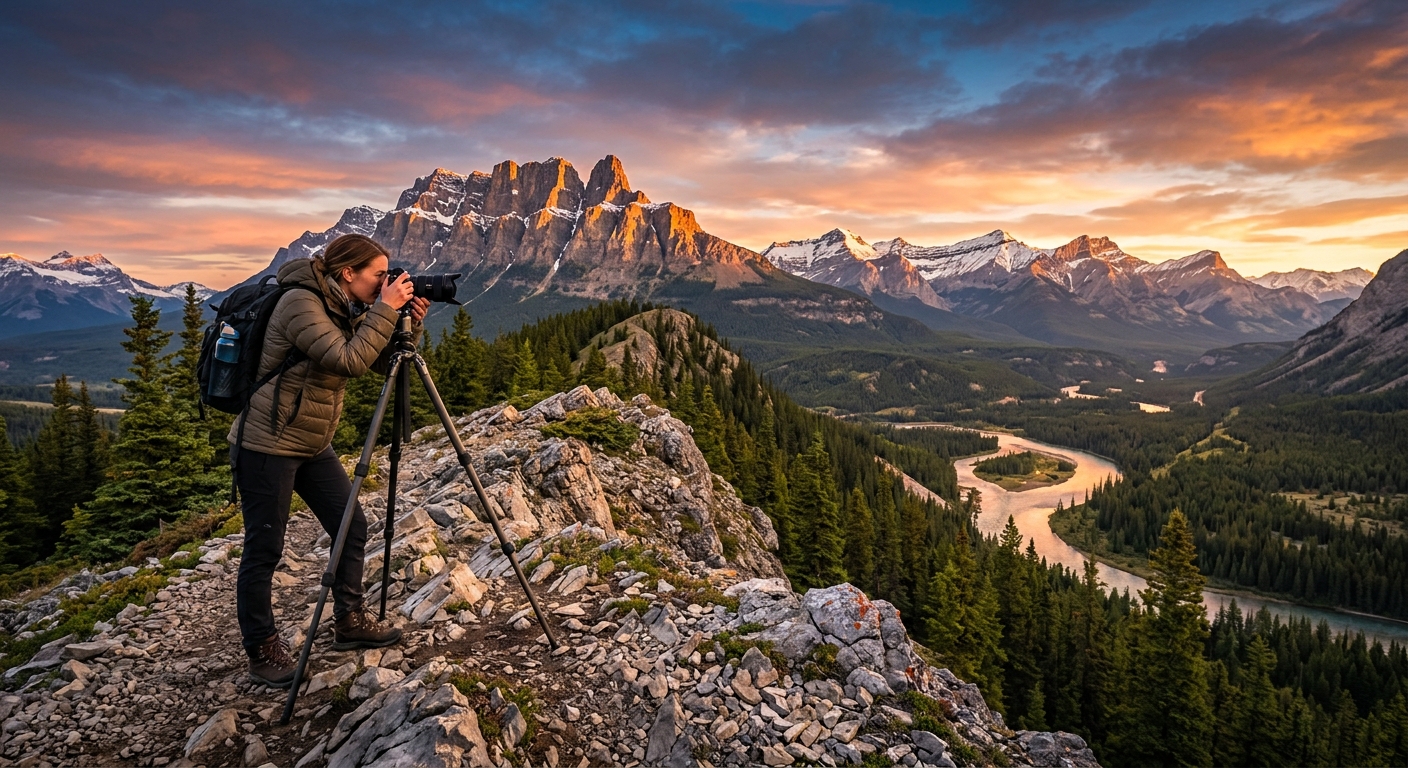
Banff National Park is one of the most photogenic places on the planet — turquoise lakes, snow-capped peaks, dramatic skies, and abundant wildlife create endless opportunities for beautiful images. But the mountain environment is demanding on both photographers and equipment. Here's a practical guide to the camera gear that will serve you best in Banff.
Camera Body
Any modern camera can capture beautiful images in Banff — from smartphones to professional DSLRs and mirrorless systems. The key considerations for a Banff trip:
- Weather sealing: Mountain weather changes rapidly. Rain, snow, and mist are common even in summer. A weather-sealed body gives you confidence to keep shooting in less-than-ideal conditions
- Dynamic range: The contrast between bright snow/sky and dark forests/shadows is extreme in the mountains. A camera with good dynamic range captures detail in both highlights and shadows
- Low-light performance: For sunrise, sunset, aurora, and wildlife in forests, good high-ISO performance matters
- Weight: If you're hiking, every gram counts. Mirrorless systems are generally lighter than equivalent DSLRs
Lenses
Wide-Angle (16–35mm equivalent)
The most important lens for Banff. Wide-angle captures the scale of mountain landscapes — sweeping valleys, towering peaks, and vast skies. A 16–35mm zoom is the workhorse lens for landscape photography in the Rockies.
- Use for: Lakeside panoramas, mountain vistas, night sky photography, aurora shots
- Recommendation: A 16–35mm f/4 offers a good balance of quality, weight, and cost. f/2.8 versions are better for night sky photography but heavier and more expensive
Standard Zoom (24–70mm equivalent)
The versatile all-rounder. Covers landscape compositions, travel shots, environmental portraits, and medium-distance wildlife.
- Use for: Versatile shooting, tighter landscape compositions, detail shots of waterfalls and rock formations
- If carrying only one lens: A 24–105mm or 24–70mm is the best single-lens choice for Banff
Telephoto (70–200mm or longer)
Essential for wildlife photography and for compressing distant mountain layers. A 70–200mm lets you photograph elk, deer, and birds at a safe distance, and isolate individual peaks or details in the landscape.
- Use for: Wildlife, distant mountain details, compressed landscape compositions, lake reflections with background compression
- For serious wildlife: A 100–400mm or 200–600mm super-telephoto reaches bears, wolves, and distant wildlife. Heavy and expensive, but if wildlife is your priority, they're worth it
Tripod
A tripod is essential for Banff photography if you want sharp landscape images, especially in low light. Key considerations:
- Carbon fibre: A carbon fibre tripod is lighter than aluminum — critical if you're hiking. The weight savings is worth the extra cost
- Travel size: A tripod that folds to 45 cm or less packs well in or on a backpack
- Stability: It needs to be stable enough to hold your camera steady in mountain wind. Ultra-lightweight tripods often shake in wind
- Ball head: A smooth ball head with Arca-Swiss quick-release makes composition adjustments fast
Filters
- Circular polarizer: A CPL filter is the single most useful filter for Banff. It deepens blue skies, reduces glare on water (revealing the turquoise colour beneath), and cuts haze. The difference in lake photographs with and without a polarizer is dramatic
- Neutral density (ND) filters: An ND filter for long-exposure waterfall shots and silky-smooth water effects. A 6-stop or 10-stop turns a roaring waterfall into a misty veil
- Graduated ND filter: A grad ND filter helps balance bright skies with darker foregrounds. Less necessary if your camera has good dynamic range, but still useful in extreme contrast
Accessories
- Extra batteries: Extra batteries — cold drains them fast. In winter, carry 2–3 spares in an inside pocket
- Memory cards: Bring more than you think you need. Banff will make you shoot more than you expect
- Lens cloth: Mist from waterfalls, rain, and condensation will coat your lens regularly
- Rain cover: A camera rain sleeve costs almost nothing and can save expensive equipment
- Camera backpack: A dedicated camera backpack distributes weight properly for hiking. Look for one with a waist belt and back-panel access
- Headlamp: A headlamp with red-light mode for sunrise shoots — you'll be setting up in the dark
Smartphone Photography Tips
If you're shooting with a phone, you can still capture gorgeous Banff images:
- Use the wide-angle lens for landscapes and the telephoto for wildlife
- Shoot in RAW mode (ProRAW on iPhone, RAW on Android) for more editing flexibility
- Use HDR mode to handle the extreme contrast of mountain scenes
- Clean your lens — phones live in pockets and get dirty
- A phone-compatible mini tripod is inexpensive and enables long-exposure night shots
Book your Banff photography trip — find accommodation on Expedia. For guided photography tours in Banff, check GetYourGuide.
Enjoyed this guide? Get weekly Banff tips.